


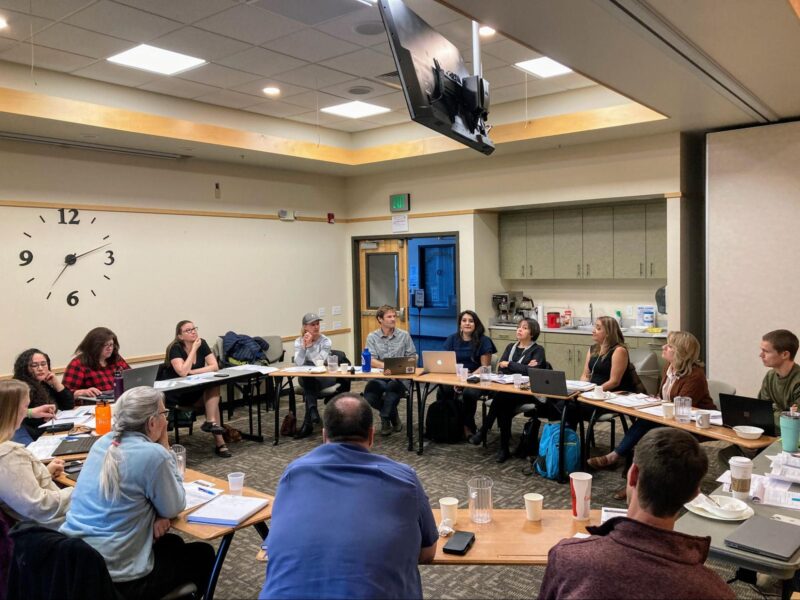
The Glenwood Springs Ad Hoc Affordable Housing Committee, a diverse group of community stakeholders, meets in 2022. The committee was convened to re-envision the future of affordable housing in the City.
Here at Community Builders, we often talk about capacity building – in fact, we think of it as one of our core capacities. But what does capacity building really mean?
Simply put, we help communities prosper by strengthening systems, structures, and policies tailored to unique local contexts. And we work to enrich civic life, helping community members and leaders get involved and shape lasting solutions.
To paint a fuller picture, let’s look at a project Community Builders partnered on with the City of Glenwood Springs in 2022 – a project that shows capacity building in action.
Downvalley Pressure
Located at the mouth of the Roaring Fork Valley, Glenwood Springs has faced growing pressure on its housing stock over the last decade, driven in part by rising costs up valley. Increased housing costs, a shortage of available units, and the displacement of working-class residents prompted the City to engage Community Builders to design and facilitate a community-led process to explore pathways toward more affordable housing.
In doing so, we helped the City convene the Glenwood Springs Ad Hoc Affordable Housing Committee. What started as an eight-week effort, evolved into an eight-month journey to reenvision the future of affordable housing in Glenwood Springs. By the end of the process, the committee issued a set of recommendations to City Council outlining housing priorities and opportunities, as well as a proposed accommodations tax for ballot consideration.

Glenwood Springs faces growing pressure on its housing stock due, in part, to rising costs in upvalley communities like Aspen, Basalt, and Carbondale.
Building Capacity
From the outset, Glenwood Springs and Community Builders knew the housing work needed to be community-driven to develop the willpower needed for the polarizing, slow-moving, and expensive work of advancing affordable housing.
We recruited community members with different demographic makeups, opinions on housing, jobs, and lived experiences to form a committee made up of lodging industry professionals, affordable housing advocates, Latina community organizers, educators, representatives from faith-based organizations, and more.
“We got called to the table because we all had different opinions,” explained committee member Maria Tarajano Rodman. “That was the first test for what the group would really be about and what it would stand for.”
Much of the committee’s time was spent building trust and conducting shared learning about housing challenges and solutions – laying the foundation for collaboration, as well as a nuanced understanding of the issue. For example, members committed to attending at least 80% of meetings, and the group decided that the final recommendation to City Council would require unanimous support.
Shared learning activities included case study reviews, presentations from housing experts, and facilitated discussions exploring community needs and tradeoffs. These layers of learning, integrated into the deliberation process by Community Builders, helped the committee settle on an actionable path forward.
“Every community can agree that we need more workforce housing,” noted committee member Sumner Schachter. “Identifying the common need and goal isn’t hard – what we do about it is the hard part. We got a diverse group, found the most practical solutions that could be implemented as quickly as possible, and paired all of that with funding sources.”
Building Projects
After eight months of deliberation, the committee recommended that City Council place a 2.5% accommodations tax on the ballot. Voters approved the measure, resulting in the creation of a municipal workforce housing fund, now administered by a citizen-led Workforce Housing Fund Advisory Board.
Today, the accommodations tax generates approximately $1.7 million annually. These funds support a range of housing initiatives, including an employer-based rental assistance program condominiumization of an apartment complex in partnership with Habitat for Humanity, a Low-Income Housing Tax Credit project, a downpayment assistance program, and multiple resident-led purchases of mobile home parks. The tax revenue also partially funds a municipal Housing Manager position – an essential part of the City’s ongoing ability to roll out housing initiatives.
“The things that we wanted to see happen are manifesting themselves,” said Tarajano Rodman. “We are preserving our mobile home parks. We are building new workforce housing. We are doing the thing.”
Together, Glenwood Springs and Community Builders convened a diverse group of community members, built trust, shared knowledge, and generated broad public buy-in – resulting in a new sustainable funding stream and administrative framework that has allowed the City to act quickly and effectively on affordable housing. This is capacity building in action.
“Our impact has been broader, more direct, and quicker than any community I can think of in the region,” added Schachter of the City’s efforts.
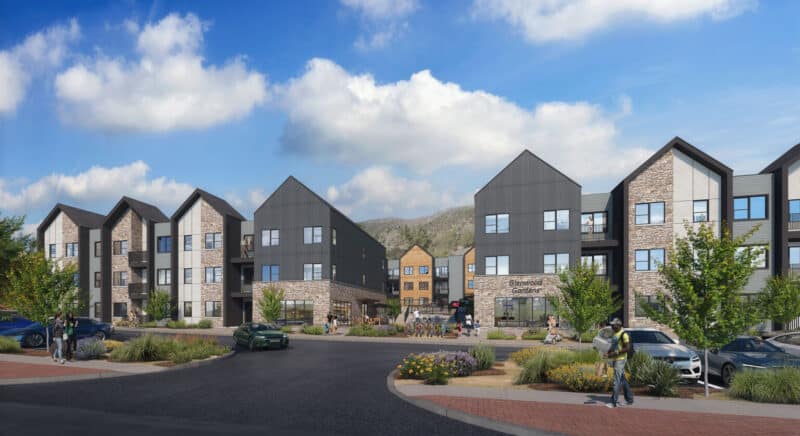
A rendering shows the future footprint of Glenwood Gardens, a LIHTC project partially funded by the Glenwood Springs Workforce Housing Fund.
Building Leaders
Tarajano Rodman, who had moved to Glenwood Springs just a year before joining the committee, continues to draw on the relationships she built through the process in her work as Executive Director of Valley Settlement, a nonprofit serving Latina families in the Roaring Fork Valley. She currently serves on several community task forces and boards.
Schachter is now an elected member of Glenwood Springs City Council where he is a steadfast advocate for affordable housing. He sees his time on the committee as both a catalyst for his current involvement in civic life and the foundation of his expertise on housing.
Since the committee’s work concluded, other members have stayed engaged in local affordable housing efforts, carrying forward their knowledge and leadership through roles with nonprofits, boards, government agencies, and other community organizations.
Building leaders and cultivating collaborative environments are a central part of our capacity building work at Community Builders. Doing so strengthens the ability of communities to come together and proactively respond to community challenges without outside help.
“What set this committee apart from others was the shared commitment to the issue,” said Tarajano Rodman. “For me, this project is a reminder of what can – and did – happen in this Valley.”
Assistance
|
Civic Health
|
Community
|
Housing